
Why Am I Homesick for a Place I Never Saw
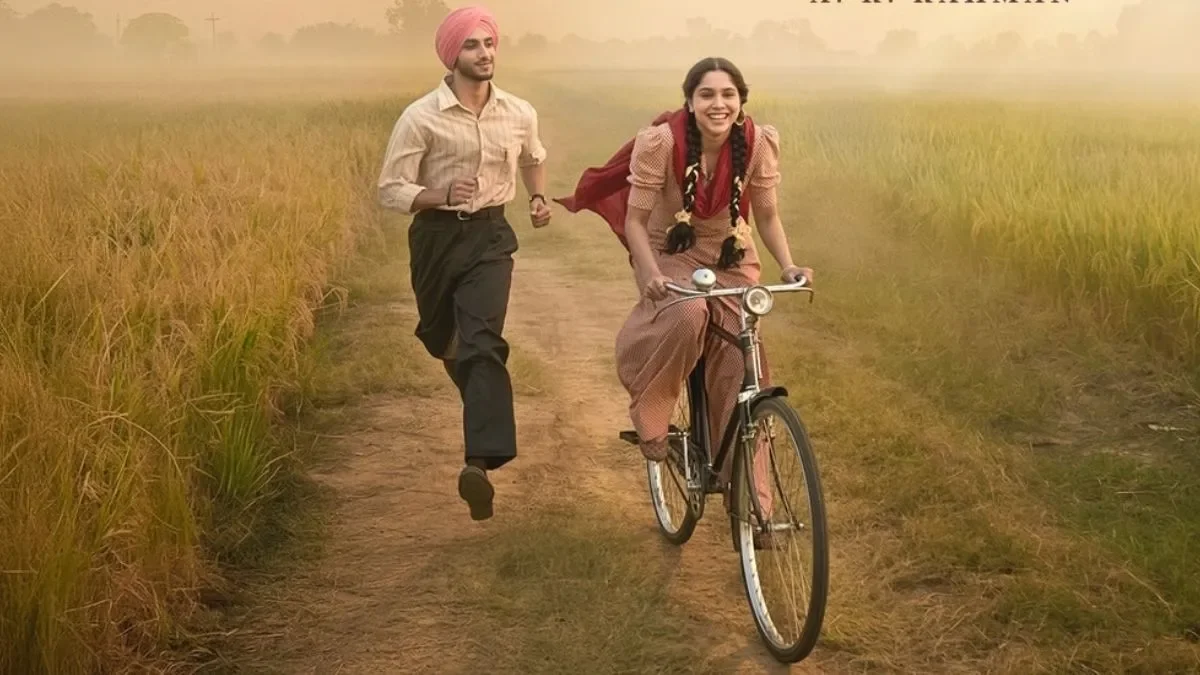
I am the granddaughter of Partition survivors, like most people my age whose roots trace back to undivided Punjab or Bengal. I proudly call myself Punjabi, but I have never seen the Punjab I ache for. I know it only through stories and films that remember Partition. Yes, I am homesick for a place I never saw. Those golden chand baalis, or the lack of one, if you’ve seen the film, Main Vaapas Aunga, hover on my mind as a remembrance of a time I never experienced.
ChatGPT tells me I am romanticising the 1940s, seeing only the highlights and not the ordinary days when life was much slower, less poetic and frankly quite sexist. Maybe. But I don’t think one feels this strongly about a time just for its artistic fittings. Of course, the galis, dastavez, and the havelis attract me to that era, but I am not repulsed by the days when it may not have been as poetic. In fact, we have always seen 1940s India through the lens of rupture, in such a calm-before-the-storm energy, that I really yearn to imagine one ordinary peaceful day from that time.
So I guess, AI can make mistakes.
But truly? What a movie, Main Vaapas Aunga is. I kid you not, while returning from the movies, I got out of the car to enter my house and I just felt a whiff of the Delhi of 1947. It was these exact roads that saw millions of refugees 79 years ago and maybe a thousand of Keenus and Jiyas, who left their hearts across the unfair Radcliffe Line.
I wonder what makes love of the olden times so great. Yes, it’s the longing, the sense of permanence, and the instant commitment - which I, as someone caught between Gen Z and millennials, often battle with. But the greatness of that love is also the helplessness. Much like how Rishi Kapoor explains it in Love Aaj Kal about his time, the ‘60s: “Mere paas option nahi tha ki main Harleen se pyaar karu ya na karu, usse rok lu ya jaane do. Humare waqt main toh bass majboori thi.” I believe being helpless is what makes love so profound. While the act of controlling love and judging it from the lens of practicality and optionality, is perhaps what broke it for our generation and for the ones to come.
But no, I am not a pessimist. Imtiaz Ali has taught me better than that.
Main Vaapas Aunga tugged at my heartstrings, I watched it with a lump in my throat. I don’t know why I feel so close to a time that I am so far removed from. During the interval, the trailer of Cocktail 2 with Kriti Sanon saying she’s not looking for permanent love and “tu bass abhi hai” - and something on the lines of not liking commitment - burst my cloud for a bit. But there’s nothing that a gripping second half of a movie and a glass of Coke cannot heal.
Here are a few things from Main Vaapas Aaunga that I cannot help but remember for their greatness:
The scene where Keenu holds Jiya tightly by her arms and looks into her eyes to say “Main nahi jaunga, Jiya”. This tugs at you just like Love Aaj Kal did with its scene when Saif’s character looks at young Harleen (Giselle Monteiro) at the sweet shop, turns away, looks up to the almighty and vows, “Yehi hi meri voti hogi, ae meri pratigya hai”. While the latter could fulfil his promise, Keenu spent shreds of his being nearly for eight decades in the angst of not fulfilling his.
And then, desperate to find the women of their family, Keenu and his father try to return to Pakistan only to have the army push them away. Keenu disregards all pushback, picks up a Pakol to appear Muslim and jumps onto the train. When his train sees the same fate as most saw along the Lahore-Amritsar track in August 1947, Keenu runs for his life, struggling to find space, with his Pakol falling off in the chaos, revealing his Sikh Pagdi to the rioters who were also, well, Sikh. And so, Keenu is not killed. For humanity was long gone from those tracks, it’s the Pagdi and Pakol that survived, and for the women who wore neither, their bodies were made to pay the price of extremism. I am surprised to see how Imtiaz Ali showed rioters from both sides - a sword was shown in the hands of a Sikh and a Muslim - an approach less taken by films these days. That’s why perhaps the seats in the movie halls are not as filled for this one. Main Vaapas Aunga shows greed for power, religious extremism and violence as the cause for so much loss, but as a population, I guess we like to have a villain, mostly another community, to somehow justify inhumanity.
Lastly, the daring Jiya, who keeps her hand on Keenu’s heart to see her impact on him, who asks point blank if he will value her less if she gives in to him quicker than she had planned, who protects him with a hug when violence erupts, and who steps out of a room to face her Muslim family, holding a Sikh boy’s hand in the dead of the night in 1940s Punjab! For the depth of her feelings depicted in the movie, her stance in front of her parents was surprisingly practical. She explicitly tells her parents that since this is not a good time for them to meet outside, the boy sneaked in to meet her. That kind of confidence seems rare even for today. The directness of it is intensified by the softness that follows when Mallika Dilfareb in Urdu script, shines on Keenu’s hand under the moonlight, and he promises Jiya that if at all he needs to leave, he will first ask her. A promise that was kept until quite literally, the end of time for both of them.
I remember having this feeling after seeing Om Shanti Om. You know how the hint of an alternate universe, reincarnation and the likes of it can influence a twelve year old. But I am thirty years old today, I am not seventeen, deep into teenage romance anymore, neither am I ninety, reminiscing Pakistani farm fields with my dupatta running through them. And yet, here we are. The Punjabi in me, the history buff in me, the lover of love in me, and of course the hopeful in me, make me love movies like Main Vaapas Aunga. These aren’t just stories of tragedy, loss and love. They are a memory of a time we will never forget as a country, or as two countries I might say. It is not just a historical event, the Partition, but rather a trigger for our sense of belonging that is passed down through stories, gestures and tears.
I often wonder what those extremists got out of raping women and butchering people in lakhs. Maybe money, religious pride, or an election win? They must have reaped its benefits for some 40 more years? Okay, and for how long do you reckon we, the children of those survivors, will carry this yearning for belonging? Perhaps centuries. For power is strong, it’s earned and respected and prideful. But it’s also fleeting and incapable of being passed on. It doesn’t sit in your bones and rush through your blood. It isn’t what we call helpless. It isn’t love.
Oh what I would give to walk the lanes of Lahore, with my grandfather on a video call navigating me through the alleys where he grew up, learned Urdu and Punjabi, danced and played. Where his mother made him a lassi malai-maarke, with her clinking bangles creating a harmony with the chirping birds along the fields. Where his father held dastavez in his hands and read slogans against the British Raj. Where one photograph was enough to capture a lifetime, and so was one promise.
..jaise tu hai paas mere, tere paas main.
Maanya Charu Kalra